🔬 Spin in Quantum Optics and Spintronics — Research Brief
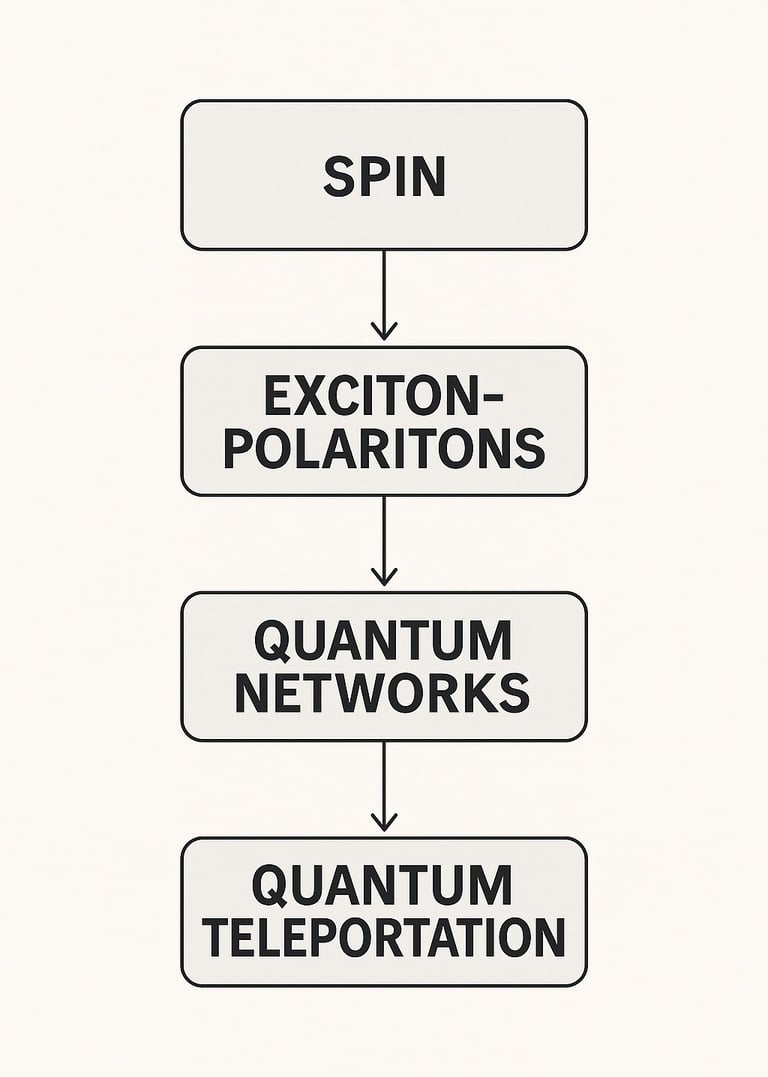
Based on the provided material, here’s a structured overview of the role of spin in quantum optics, photonics, and teleportation:
📌 What Is Spin?
Definition:
Spin is a fundamental quantum property of particles, analogous to internal angular momentum.
• Electron: spin = ±½
• Photon: spin = ±1 (right- or left-handed polarization)
Quantum role:
Spin can exist in a superposition of states (“up” and “down” simultaneously), making it an ideal qubit in quantum information systems.
💡 The Role of Spin in Optics and Photonics
1. Polarization = Photon Spin
Light polarization is directly linked to photon spin. Controlling spin means controlling information flow in photonic circuits.
2. Exciton-Polaritons
• Hybrid quasiparticles (photon + exciton in semiconductors)
• Possess spin degrees of freedom
• Enable technologies such as: spin lasers, optical switches, quantum logic gates
3. Spin-Orbit Coupling of Light
In nanophotonic structures, photon spin can be manipulated locally — a gateway to miniaturized quantum devices.
📡 Spin and Quantum Teleportation
Although the lab (at St. Petersburg State University) does not directly perform quantum teleportation, its research is foundational for:
• Quantum Interfaces
Spin states of photons, electrons, and polaritons can serve as mediators for transferring quantum information between systems (e.g., photonic qubits ↔ trapped atoms).
• Reliable Information Transfer
Spin states in materials (e.g., NV centers in diamond, quantum dots, polariton condensates) exhibit long coherence times — essential for storing and transporting quantum states.
• Hybrid Systems
Spin physics connects photonic, electronic, and atomic systems, enabling the creation of hybrid quantum networks — a cornerstone of the quantum internet.
🧪 Research Directions at SPbU
1. Spin-Based Optical Chips
Encoding information in photon polarization on photonic chips.
2. Spin-Polariton Logic Elements
Using spin-polaritons for quantum computing logic circuits.
3. Topological Materials and Spin
Exploiting spin effects in topological insulators for robust information transfer.
4. Coherent Quantum Signal Generation
Leveraging spin states in polariton condensates to generate coherent quantum light sources.
✅ Summary
While the Spin Optics Laboratory at SPbU doesn’t conduct quantum teleportation experiments directly, its pioneering work in:
• spin physics,
• exciton-polaritons, and
• nanophotonics
lays the groundwork for:
• transmitting and storing quantum states,
• building resilient communication infrastructure,
• and realizing future quantum networks.



✨ Neural and Quantum Modulation Methods
In the NiTi Quantum Therapy System and the Gamma-17 Technology
NiTi quantum therapy views the brain as a dynamic system in which biochemical processes interact with quantum — spin-based, wave-based, and resonant — states.
Each mechanism is described through two layers:
1. Scientific (neurobiological)
2. Quantum / resonant (NiTi Method + Gamma-17)
1. Serotonin Activity
🔬 Scientific Mechanism
Serotonin is a key neuromodulator responsible for:
• mood and emotional stability,
• sleep quality,
• brain plasticity,
• the formation of new neuronal connections.
Its function depends on 5-HT receptors, which regulate the flow of information between the limbic system and the prefrontal cortex — the center of conscious decision-making.
✨ NiTi Resonance Mechanism
The NiTi Method uses quantum-frequency tuning to:
• stabilize brain rhythms,
• reduce chaotic limbic overactivation,
• shift consciousness into the state of inner stillness.
The Gamma-17 device acts as a resonant amplifier aligning:
• serotonergic rhythms,
• DNA vibrational states,
• coherent states of consciousness.
Result: greater inner calm, clarity, and emotional resilience.
2. Glutamatergic Transmission
🔬 Scientific Mechanism
Glutamate is the primary excitatory neurotransmitter responsible for:
• learning,
• memory formation,
• synaptic strengthening (LTP — long-term potentiation).
Excess glutamate = stress, anxiety, neural overload.
Balanced glutamate = optimal neuroplasticity and cognitive performance.
✨ NiTi Resonance Mechanism
The NiTi Method shifts the brain into a coherent operating mode where:
• glutamate-related noise decreases,
• precision of neural signaling increases.
Gamma-17 stabilizes spin states within neural networks, reducing chaotic excitation and supporting high-efficiency neural processing.
3. Neurotrophic Factors (BDNF)
🔬 Scientific Mechanism
BDNF is the primary growth factor of the nervous system. It:
• stimulates new synaptic connections,
• protects neurons from degeneration,
• accelerates recovery after stress,
• improves learning and memory.
Any therapy that elevates BDNF improves overall cognitive health.
✨ NiTi Resonance Mechanism
NiTi induces a state of quantum neuroplasticity where:
• the brain synchronizes with the body’s inner frequency field,
• fractal-holographic DNA patterns activate,
• cells receive a biological “command” to grow and regenerate.
Gamma-17 amplifies DNA biophoton emission, which modern research associates with increased BDNF and enhanced intercellular communication.
4. Mitochondrial Activity
🔬 Scientific Mechanism
Mitochondria are the cell’s energy engines. They:
• produce ATP,
• regulate cell survival,
• govern stress resistance,
• support neuronal function and memory.
Higher mitochondrial activity = greater vitality and mental performance.
✨ NiTi Resonance Mechanism
NiTi works as a frequency-wave activator of cellular energy.
Gamma-17 generates:
• resonant fields that enhance electron transport in mitochondria,
• optimized electron spin states (known to influence ATP output),
• improved energy metabolism throughout the body.
✨ Complete Catalogue of NiTi Quantum Therapy Mechanisms
I. Neural Mechanisms
1. Stabilization of serotonergic rhythms
2. Optimization of glutamatergic transmission
3. Increase of BDNF and neuroplasticity
4. Strengthening of cortico-limbic integration
5. Transition of the brain into a coherent perceptual state
II. Quantum–Informational Mechanisms
6. Spin-state modulation of neural networks
7. DNA resonance and biophoton emission enhancement
8. Normalization of torsion-informational flows
9. Activation of fractal–holographic cellular memory
10. Strengthening of the “quantum dialogue” between consciousness and the field
III. Cellular Mechanisms
11. Mitochondrial energy amplification
12. Enhancement of cellular regeneration
13. Improvement of intercellular communication and synchronization
Contact Us
Reach out to us for questions or information about visits
Get in touch with us
E-Mail: gamma17vegas@gmail.com
Ph: +1-917-574-4209
© 2025. All rights reserved.